
Can Anal Fistula Be Treated Without Surgery? A Specialist Explains
Having an anal fistula can be uncomfortable. You may suffer from pain, swellings, irritation and constant discharge around the anal region. Many people will look up “anal fistula treatments without surgery” to find out whether there is a way to treat their fistula without any cuts or stitches.
Can an anal fistula be cured with medication? Or can natural remedies and laser treatments help?
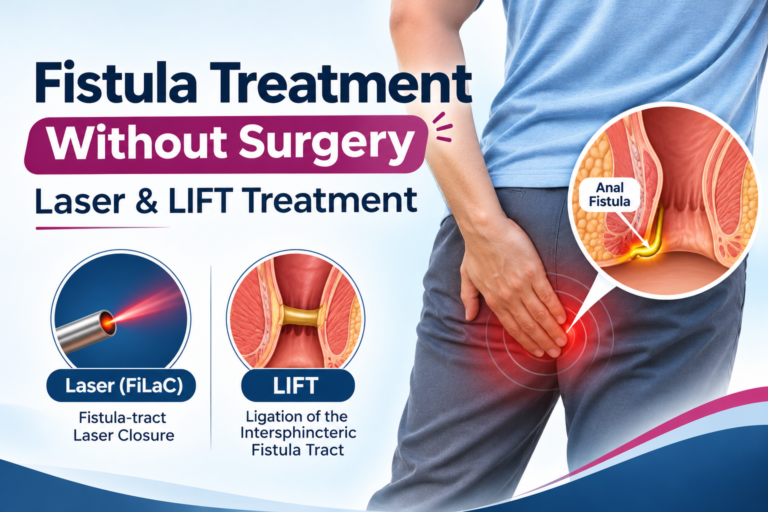
Whether or not anal fistula can be treated without surgery depends on the type of fistula that you have. Whilst an established fistula will normally not fully heal on its own, modern techniques such as laser treatment (FiLaC) or LIFT can be used to treat your fistula with minimal invasiveness.
By undergoing a proper examination with your colo-proctologist you can identify the fistula tract and what treatment is best for you.
Quick Answer: Can Anal Fistula Be Treated Without Surgery?
Anal fistulas cannot generally be cured with medication or natural remedies. Medication can help ease some of the discomfort but cannot reliably close the fistula tract.
However, some treatment options such as FiLaC laser treatment and LIFT can be used for treating fistulas without surgery. These treatments aim to treat your fistula whilst protecting the anal sphincter muscles.
The best treatment option will depend on the type and complexity of your fistula. Your specialist can advise on what treatment is best for you after examining your fistula tract.
What Is an Anal Fistula and Why It Doesn't Heal by Itself
An anal fistula is a small tunnel that has developed between the inside of your anal canal and the surrounding skin. They often develop after an anal abscess has occurred.
Sometimes after the abscess has drained, a narrow tunnel will form between the anal canal and the skin. This is known as an anal fistula.
Common Symptoms of an Anal Fistula
Everyone will experience symptoms differently. Common symptoms include:
- Pain and discomfort around the anal region
- Swelling and redness around the anal opening
- Pus and/or fluid leaking from a small hole around the anus
- Constant swelling and/or abscess
- Irritation and itching around the area
- Pain when sitting down and passing stools
- Blood stained fluid in some cases.
Why Can’t an Anal Fistula Heal Naturally?
An anal fistula isn’t just an open wound on the outside. There is a tunnel running from the inside of your anal canal.
Whilst the outside hole may appear to heal, the tunnel may still be present underneath causing constant leakage, infection, swelling and/or abscess.
Therefore it may not be a good idea to just leave your fistula to heal. A specialist examination can help you understand your condition and what treatment is best.
Do Home Remedies or Medicines Work?
Many people will try using natural remedies when experiencing fistula symptoms. Whilst they may help ease some symptoms, they cannot fully close an established fistula tract.
Natural remedies can help keep the area clean, reduce irritation and make passing stools more comfortable.
Things Natural Remedies Can Help With
- Warm sitz baths – Taking a short bath in comfortably warm water.
- Good hygiene – Gently washing the anal area after passing stools.
- Eating high fibre foods – Eating plenty of fruit, vegetables and wholegrains.
- Drink plenty of water – This will help to prevent constipation.
- Try not to strain – Try not to put any pressure when passing stools.
Can Medication Help?
Medication may help with some symptoms. Doctors may prescribe pain relief medication or antibiotics if required.
However, medication will generally not fully close the fistula tract. Therefore symptoms may return.
It is best to see a specialist.
Minimally Invasive Options: Laser (FiLaC), LIFT, LIFT + FiLaC
Over the years, treatments have been developed to treat anal fistulas. For some patients, minimally invasive treatments can be used to treat your fistula whilst also protecting your anal sphincter muscles.
Which treatment you will receive will depend on the type, complexity and amount of sphincter muscle involved.
1. FiLaC Laser Treatment for Fistula
FiLaC (Fistula-tract Laser Closure) is a minimally invasive treatment for fistulas. A special laser fibre is passed carefully into the fistula tract.
The laser fibre delivers an energy to help close the tract. This aims to treat your fistula whilst keeping the surrounding sphincter muscles intact.
Benefits:
- Minimally invasive treatment
- Smaller incision made
- Sphincter muscle preserving
- Less wound discomfort in some patients.
However, FiLaC may not be suitable for all types of fistulas. Healing cannot be guaranteed and the fistula may return. Your doctor will be able to advise whether this treatment is best for you.
2. LIFT Procedure for Fistula
LIFT (Ligation of the Intersphincteric Fistula Tract) is a sphincter muscle preserving treatment for certain anal fistulas. It is useful for fistulas that run through the sphincter muscles.
The surgeon will locate the fistula tract in the gap between the sphincter muscles. The tract is then tied and cut to prevent the abnormal connection.
Benefits:
- Sphincter muscle preserving
- May be suitable for certain complex fistulas.
- Aims to reduce the risk of bowel control issues by cutting the sphincter muscle.
The outcome will depend on the structure of the fistula and how quickly you heal. Your specialist can advise whether this treatment is suitable for you.
3. LIFT + FiLaC Treatment
In some cases, the surgeon may decide to combine LIFT and FiLaC treatment.
The LIFT treatment may be used to close the internal opening. Then the tract can be treated with laser energy.
This is not required for all patients. It will only be considered for certain patients after careful consideration of the tract, branching and complexity.
Laser Fistula Treatment vs Traditional Fistulotomy
There are two different ways of treating an anal fistula. The best treatment will depend on your condition.
Laser Treatment (FiLaC)
FiLaC uses laser energy to treat the tract from the inside. This aims to close the tract whilst keeping the sphincter muscles intact. As the incision is normally smaller, some patients may experience less wound discomfort.
Healing will depend on the complexity of the fistula.
Traditional Fistulotomy
The fistula tract is opened along the tract so it can heal slowly from the inside. This is commonly considered for simple low fistulas as there is a low risk of affecting the sphincter muscles.
Depending on the location of the fistula, some sphincter muscle may need to be cut. The wound will then heal. How quickly it heals will depend on the size of the wound.
Which Treatment Is Best?
There isn’t one treatment that will be best for everyone.
FiLaC may be considered if protecting the sphincter muscles is important. However, Fistulotomy may be suitable for some simple low fistulas.
Your colo-proctologist will examine your fistula tract and surrounding muscles to advise what the best treatment is for you.
Risks of Delaying Treatment
Leaving your anal fistula may cause more issues. By not seeing a doctor, your symptoms may continue and you could experience further problems.
Possible issues include:
- Constant abscess – Infection could build up again causing swelling, pain and discomfort.
- Constant leakage – The fistula may leak constantly.
- More discomfort – Constant irritation and inflammation can cause discomfort when sitting.
- Complex Fistula – In some cases the tract may branch out making it harder to treat.
- Constant infection – Symptoms may return.
Seeing your specialist early can help them understand the structure of your fistula and what treatment is best.
Recovery After Laser Fistula Treatment
Recovery will vary between individuals. It will depend on the type of fistula, treatment and how your body reacts.
Most patients will be advised to follow your surgeons advice.
What to Expect
- First few days – You may experience some pain, slight discomfort and leakage. Take your medication as prescribed and follow the advice for your wound.
- First Week – Many patients will start to do light daily activities as they become more comfortable. However this will depend on your comfort and what your surgeon advises.
- Following Weeks – The area will continue to heal. You will have regular follow up appointments.
- Full Healing – This will depend on your fistula and how quickly you heal.
Tips for Recovery
- Keep the area clean as advised.
- Take your medication as prescribed.
- Drink plenty of water throughout the day.
- Eat plenty of fibre rich foods.
- Avoid constipation and straining when passing stools.
- Take warm sitz baths if advised by your doctor.
- Avoid heavy exercise until advised by your surgeon.
- Don’t miss any follow up appointments.
If you experience any fever, increased pain, heavy bleeding or increased swelling please contact your doctor.
When to See a Colo-Proctologist
If you are experiencing constant leakage, swelling and/or pain around your anus you should not ignore these symptoms. This could be an indication of an anal fistula or another anorectal issue.
You should consider seeing a colo-proctologist if you are experiencing:
- Constant leakage of pus
- A small hole/wound that won’t heal
- Constant swelling and/or painful lumps around the anal region
- Pain when sitting and/or passing stools
- Constant anal abscess
- Constant irritation and/or discomfort around the anus.
Your doctor may carry out a physical examination and recommend further tests such as an MRI. This will help identify the tract and how it relates to the surrounding muscles.
Once assessed, your specialist can discuss what treatment is best for you.
Frequently Asked Questions About Fistula Treatment
Find answers to common questions about anal fistula, laser treatment, minimally invasive procedures and recovery.
Can an anal fistula heal naturally?
Generally, an established anal fistula does not heal completely on its own. The external opening may close temporarily, but the underlying tract can remain and cause recurring infection, discharge or abscess formation. A specialist can examine the fistula and recommend appropriate treatment.
Can fistulas be treated without cutting?
Some anal fistulas can be treated using minimally invasive techniques such as FiLaC laser treatment. These procedures aim to treat the fistula tract while limiting damage to the surrounding sphincter muscles. However, suitability depends on the fistula's location, complexity and relationship with the sphincter muscles.
What is the best treatment for an anal fistula?
The appropriate treatment depends on the type, location and complexity of the fistula. Options may include fistulotomy, FiLaC laser treatment, LIFT procedure or other surgical techniques. A specialist evaluates the fistula tract and surrounding muscles before recommending a suitable treatment approach.
Will natural remedies help cure an anal fistula?
Natural remedies cannot reliably close an established anal fistula. Warm sitz baths, proper hygiene, adequate water intake and a high-fibre diet may help manage discomfort and prevent constipation. However, these measures do not eliminate the fistula tract, and medical evaluation is important.
Is laser treatment for fistulas painful?
FiLaC laser treatment is generally performed under anaesthesia. Some patients may experience soreness, discomfort or mild pain during recovery. The level of discomfort varies depending on the fistula and procedure. Your doctor may prescribe medication to help manage post-treatment discomfort.
What is FiLaC laser treatment for fistulas?
FiLaC (Fistula-tract Laser Closure) is a minimally invasive procedure that uses a specialised radial laser fibre to deliver controlled energy along the fistula tract. This helps shrink and close the tract while aiming to preserve the surrounding sphincter muscles. It may be suitable for selected patients depending on the fistula's anatomy.
What is LIFT treatment for anal fistulas?
LIFT stands for Ligation of the Intersphincteric Fistula Tract. During this procedure, the surgeon identifies the fistula tract in the space between the internal and external sphincter muscles, then ligates and divides it. The technique aims to treat the fistula while preserving sphincter function and may be suitable for selected fistulas.
How long will I be recovering from my fistula surgery?
Recovery depends on the type of procedure, fistula complexity and individual healing. Some patients may resume light daily activities within a few days, while complete healing can take several weeks or longer. Following your surgeon's instructions regarding wound care, hygiene, medication and activity restrictions is important.
What will happen if I leave my anal fistula untreated?
An untreated anal fistula may cause persistent discharge, pain, recurring infections and abscess formation. In some cases, the tract may develop additional branches and become more complex to treat. Seeking medical advice can help identify the condition and determine appropriate treatment.
Can an anal fistula return after laser treatment?
Yes, an anal fistula can recur after FiLaC laser treatment. The possibility of recurrence depends on factors such as fistula complexity, branching, the location of the internal opening and individual healing. Regular follow-up appointments help your specialist monitor recovery and identify any signs of recurrence.

No comment