
Proctocare Clinic — Dr. Rajendra Sonavane
Best Piles Doctor in Mumbai — Painless Laser Treatment
40+ years of experience, M.S., F.I.C.S., F.I.A.G.E.S. — trained in laser surgery in Germany & Poland. Day-care procedures, cashless support & no-cost EMI available across 5 Mumbai locations.
A painful, swollen lump at the base of the spine — just above the buttocks — is something I see often, especially in young men, office workers, and long-distance drivers. Many patients live with the discomfort and recurring discharge for months, feeling too embarrassed to seek help, or hoping it will simply go away. That lump is often a pilonidal sinus, and the reassuring news is that it’s very treatable — today, often with a simple, painless laser procedure. In this guide, I’ll explain what a pilonidal sinus is, why it happens, and when surgery becomes necessary.
What is a pilonidal sinus?
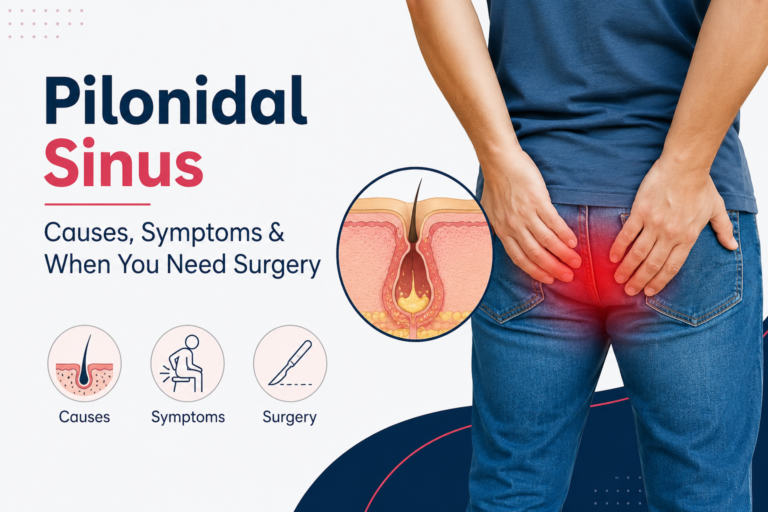
A pilonidal sinus is a small tunnel or tract that forms in the skin, usually in the cleft at the top of the buttocks, near the tailbone. It often begins as a tiny pit or dimple and can develop into an infected cavity. Interestingly, it’s not a true cyst — it typically forms around trapped hair, which is why it’s so closely linked to body hair and friction in that area.
What causes a pilonidal sinus?
The condition usually develops when a loose hair burrows back into the skin. The body treats this hair like a foreign object (much as it would a splinter) and mounts an inflammatory response, forming a cavity that can become infected. Several factors raise the risk: excess body hair, a deep natal cleft, prolonged sitting (which is why it’s sometimes called “jeep disease” among drivers), friction, obesity, a sedentary lifestyle, excessive sweating, and a family tendency. It most commonly appears in young adults after puberty, and more often in men.
Symptoms of a pilonidal sinus
The symptoms range from very mild to quite troublesome. You may notice:
- A small dimple, pit, or opening in the skin near the tailbone
- Pain or discomfort, especially when sitting or bending
- Swelling, redness, and tenderness in the area
- Discharge of pus or blood, sometimes with a foul odour, or a feeling of dampness in the cleft
- A painful abscess (a swollen, infected lump) during a flare-up
- Recurring episodes of infection and discharge
Some pilonidal sinuses cause no symptoms at all and are only noticed as a small pit.
When do you need surgery?
This is the crucial question. A small, painless pit with no symptoms may not need surgery at all — it can often be managed conservatively with good hygiene, hair removal, and avoiding prolonged sitting. However, treatment becomes necessary when the sinus causes trouble:
- An acute abscess needs prompt drainage to relieve the pain and infection.
- A chronic or recurrent pilonidal sinus — with ongoing pain, repeated infections, or persistent discharge — needs definitive surgery to remove or close the sinus tract for good.
In short, once it’s causing repeated symptoms, treatment is the sensible path.
Complications of ignoring it
I always caution patients not to keep delaying treatment. An untreated pilonidal sinus can lead to repeated painful abscesses, chronic infection, and the formation of additional tracts or a fistula. Very rarely, a long-standing, neglected sinus can undergo cancerous change. Timely treatment prevents all of this.
How is it diagnosed?
Diagnosis is usually straightforward. I can identify a pilonidal sinus through a simple clinical examination of the area, assessing the openings, any discharge, and the extent of the tract. No complicated tests are typically needed.
Treatment options
Treatment is tailored to the severity of the condition:
- Conservative care for mild cases: meticulous hygiene, hair removal, and avoiding long periods of sitting.
- Antibiotics to control infection (though these alone don’t cure the sinus).
- Incision and drainage for an acute abscess.
- Traditional surgery (excision), where the sinus is cut out; the wound is then either left open to heal gradually or closed with stitches or a flap. This is effective but more invasive, with a longer recovery.
- Laser treatment, the modern, minimally invasive option I most often recommend.
Laser treatment for pilonidal sinus
Laser treatment has transformed pilonidal sinus care. A fine radial laser fibre is used to gently close and destroy the sinus tract from the inside, without a large open wound. The advantages are significant: it’s performed as a day-care procedure under local anaesthesia with sedation, usually takes around 15 to 30 minutes, causes minimal pain, leaves no large wound to pack, and allows a much faster return to normal life. Success rates are high and recurrence is low, especially when combined with laser hair removal of the area to prevent future hair from burrowing back in.
Preventing recurrence
Because pilonidal sinus tends to recur, prevention matters. I advise patients to keep the area clean and dry, to remove hair regularly (laser hair reduction is ideal), to avoid prolonged sitting and take breaks, and to maintain a healthy weight. These simple steps greatly reduce the chance of it returning.
Expert pilonidal sinus treatment at Proctocare Clinic
If you’re troubled by a painful lump or recurring discharge near your tailbone, please don’t suffer in silence. At Proctocare Clinic, I offer advanced, painless laser treatment for pilonidal sinus, with day-care procedures, NABH-accredited hospitals, cashless facilities and No-Cost EMI. Clinics are available across Kalyan, Dombivli, Thane, Goregaon and Malad.
📞 Book a consultation: +91 80971 01000 · Dr. Rajendra Sonavane, Proctocare Clinic — Mumbai & Thane
Frequently Asked Questions
- Is a pilonidal sinus dangerous?
It’s not dangerous in itself, but if left untreated it can cause recurrent abscesses, chronic infection, and rarely more serious problems. Timely treatment prevents complications. - Can a pilonidal sinus heal without surgery?
Small, symptom-free pits may be managed with hygiene and hair removal. But recurrent or infected sinuses usually need surgery to resolve permanently. - Is laser treatment for pilonidal sinus painful?
Laser treatment is minimally invasive, done under local anaesthesia, and causes little pain, with no large wound to heal and a quick recovery. - What causes a pilonidal sinus?
It usually forms when loose hair burrows into the skin near the tailbone, triggering inflammation. Prolonged sitting, excess body hair, and friction increase the risk. - How long is recovery after laser pilonidal sinus surgery?
Most patients go home the same day and return to routine activities within days, with the area healing over the following few weeks. - Can a pilonidal sinus come back after treatment?
It can recur, but the risk is low with laser treatment, especially when combined with hair removal and good hygiene afterwards. - Which doctor treats pilonidal sinus?
A proctologist or colorectal surgeon treats pilonidal sinus. At Proctocare Clinic, it’s managed with advanced laser techniques.
Frequently Asked Questions
The squatting posture straightens the anorectal angle and reduces straining, which can help prevent or ease piles. However, the best choice also depends on your comfort, mobility, and the stage of your piles.
A Western toilet doesn't directly cause piles, but sitting upright requires more straining, and it can tempt people to sit for long periods — both of which increase pressure on the anal veins.
The squatting posture — knees above the hips — is ideal. On a Western commode, you can achieve this by placing a footstool under your feet.
Yes. A footstool of about 7–9 inches raises your knees and mimics squatting, straightening the passage and reducing the straining that worsens piles.
If squatting is painful or you have severe or thrombosed piles, use a Western commode with a footstool instead. Comfort and avoiding strain are what matter.


No comment